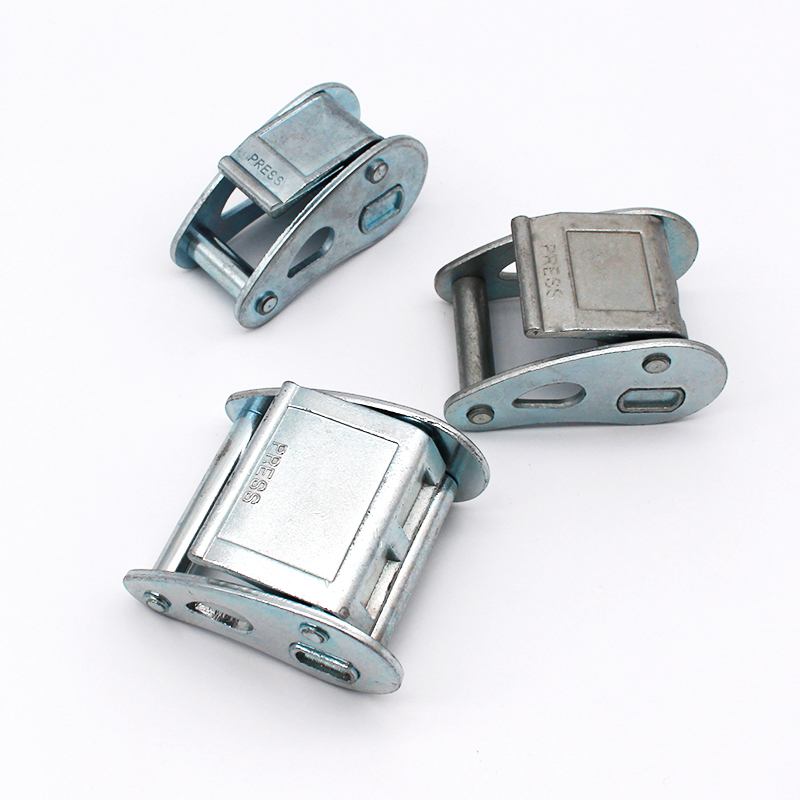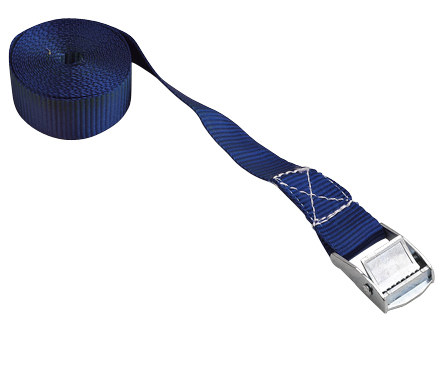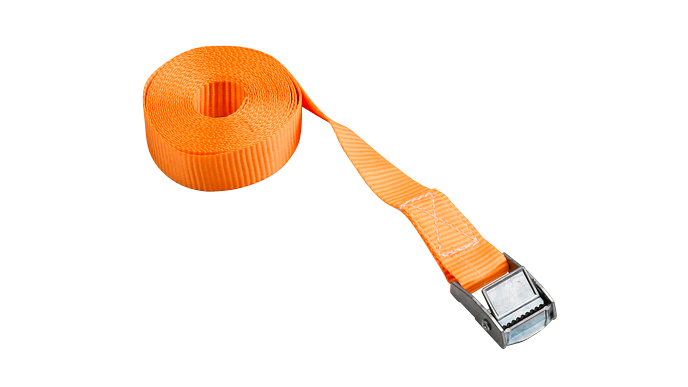
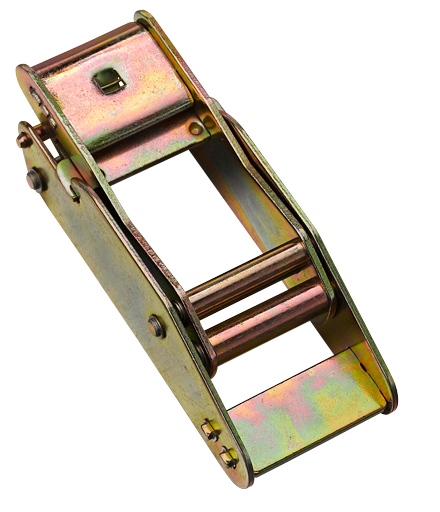
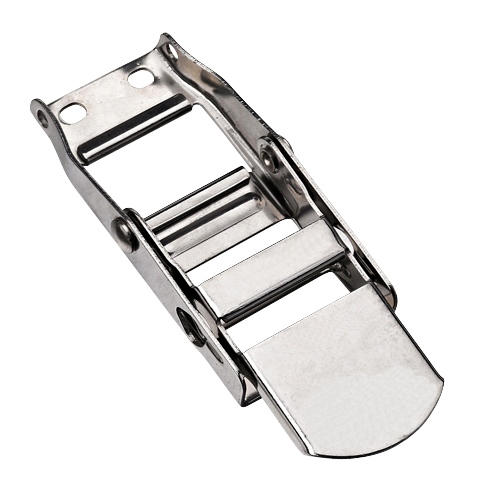
An over-center buckle is a cargo securement device that uses a toggle-lock mechanism — when the handle is pushed past the center point, it snaps into a locked position that holds tension without continuous force. Unlike ratchet straps, which rely on a lever-and-pawl mechanical advantage, the over-center buckle locks through geometry alone, making it faster to engage and release.
Key Takeaways
- Lay the straps flat at the widest point of the cargo to evenly distribute the securing force—twisting or knotting polyester webbing concentrates the load in a narrow contact area, reducing its strength at the point of stress.
- Do not set a fixed tension value: the correct tension should secure the cargo without exceeding the working load limit (WLL) indicated on the strap label.
- Inspect the straps before each use: check for cuts, abrasions, chemical damage, and ensure the label is legible. Straps with missing or illegible labels must be discontinued.
- After securing, perform a final system check: ensure the straps are taut and not visibly loose, the buckles are centered and fully locked, and the webbing is free of twisting or edge damage at the contact points.
- This over-center buckle locking mechanism relies on geometric actuation, not simple friction, meaning the handle must completely pass the center position. If the handle is not fully closed, it may loosen due to vibration during transport.
Over center buckle steps
Strap Placement
Properly positioned straps distribute the securing force across the widest part of the cargo, minimizing localized stress and reducing the risk of cargo shifting during emergency braking or turning. Lay the polyester webbing flat over the cargo surface—polyester (PET) is the industry-standard material for cargo securing straps because of its low elongation under load and high resistance to UV degradation and moisture, unlike polypropylene, which creeps under sustained tension. Never allow the webbing to twist or knot, as this concentrates tension on a narrow cross-section, effectively reducing the strap’s strength at the point of deformation.
| Material Type | Description |
|---|---|
| High Strength Polyester Webbing | Industrial webbing that stretches very little under weight. |
| Heavy Duty Metal Buckle Construction | Strong steel with extra support for heavy loads. |
| Corrosion Resistant Surface Options | Special coatings or stainless parts for use outdoors or near water. |
Threading the buckle
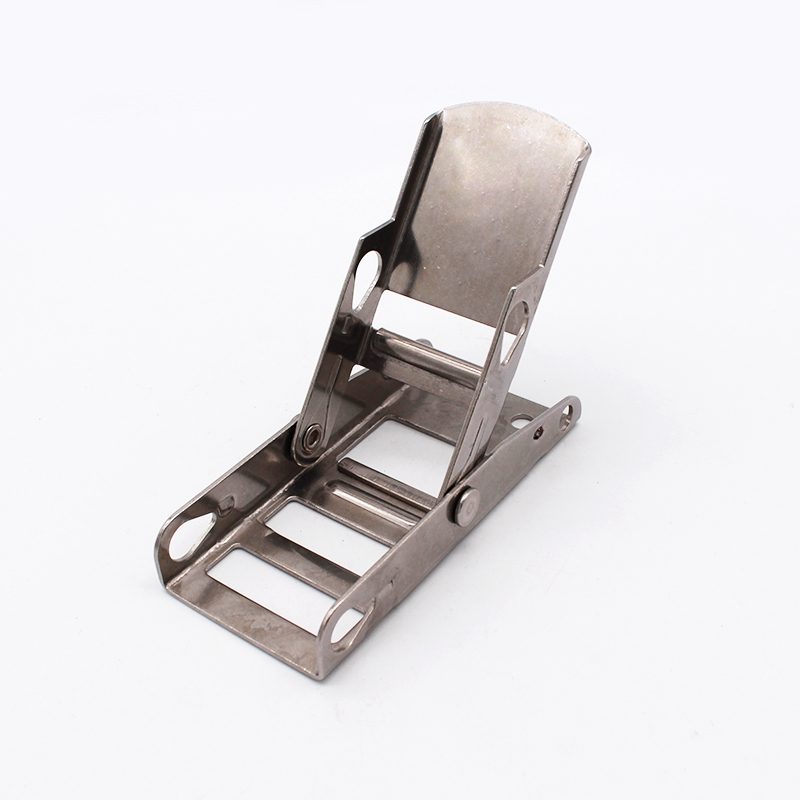
Correct threading is essential because the webbing path determines whether the toggle-lock mechanism can engage properly when the handle is closed. Follow this sequence: Start with the buckle handle in the open (vertical) position, rivets at the top. Insert the webbing end through the lower slot of the handle, then feed it back out through the upper slot — this creates the S-shaped path that the cam surface grips when tension is applied. Pull the strap tight while the handle stays open to remove all visible slack. Throughout threading, keep the strap flat and free from twists, and verify the buckle is centered on the cargo face so that tension distributes evenly rather than pulling at an angle. A common error is feeding the webbing reversed (top-down instead of bottom-up), which prevents the locking surface from engaging when the handle closes.
Applying tension
With the handle open, pull the webbing tail taut to eliminate any slack. There is no uniform tension value: the required tension should be sufficient to hold the load without exceeding the webbing’s Working Load Limit (WLL). The WLL is printed on a label, which also includes the manufacturer’s name, material code, and traceability number. The WLL of a particular webbing is typically one-third of its Minimum Breaking Strength (MBS). Use the pull tab to tighten any remaining slack until the webbing is taut by hand, then close the handle to engage the over-center lock.
Locking and securing
The locking step is crucial for the toggle mechanism to function. Rotate the handle downwards from the open (vertical) position to the closed position. As the handle passes its pivot point, the geometry reverses: the tension of the webbing that previously pulled the handle open now tightens it—forming a self-reinforcing lock that won’t disengage even under road vibrations. For models equipped with a lever or spring-loaded locking latch, this auxiliary locking device must produce a click to confirm that the main toggle lock is fully engaged. A partially closed handle that hasn’t fully passed the pivot point will disengage under vibration. Always verify this by attempting to lift the handle without pressing any release latch; the handle should not move.
Safety check
A final safety check keeps the cargo and people safe. Look at the strap to see if it is tight and lined up right. Make sure the buckle is in the center and the webbing has no twists or damage. Check places that get a lot of stress, like seams and closures, for wear. Replace straps with deep cracks, lots of fraying, or if they do not stay tight.
If you follow these steps, you can keep cargo safe and lower the chance of it moving or getting damaged during transport.
Tips for safe use Over center buckle
Common mistakes
| Mistake | Consequence | Prevention |
|---|---|---|
| Insufficient tension | Cargo shifts during transit; strap goes slack | Pull hand-tight before closing handle; re-check after first mile of travel per FMCSA §392.9 |
| Buckle off-center | Uneven webbing stress; buckle body contacts cargo edge and abrades | Center buckle on the flattest cargo face before final tensioning |
| Over-tensioning | Exceeds WLL; webbing yields or buckle frame distorts | Never exceed WLL marked on label; use a tension indicator if loads approach WLL |
| Twisted webbing | Load concentrated on a narrow cord rather than full webbing width; effective strength reduced at the twist point | Run hand along full webbing length before locking |
| Handle not fully past center | Toggle lock not engaged; handle releases under vibration | Verify handle is flat against webbing and does not lift without pressing release |
Troubleshooting
| Symptom | Likely Cause | Solution |
|---|---|---|
| Handle will not close | Webbing path reversed or buckle fouled with debris | Re-thread bottom-up; clean buckle with mild solvent; inspect for bent frame |
| Handle closes but does not lock | Worn cam surface or bent pivot pin | Inspect pivot for deformation; replace buckle if cam teeth are rounded or pivot has play |
| Strap slips after locking | Webbing contaminated (oil/grease) or worn smooth | Clean webbing with mild soap and water; replace if surface is glazed or fibers are flattened |
| Rust on buckle | Zinc plating worn through; exposure to moisture | Remove surface rust with fine steel wool; apply corrosion inhibitor; replace if pitting exceeds 0.5 mm depth |
Benefits of over center buckle straps
Over center buckle straps are fast to use and easy to open. They hold things steady while you move them. BAOYING straps use strong polyester webbing and tough steel buckles. These parts make the straps last long and work well for business jobs. The straps meet ISO 9001, CE, and GS rules, so they are good for shipping and factory use.
Doing each step when you use an over center buckle helps keep things safe. It also makes sure your cargo stays in place. The table below shows that using it the right way can lower accidents and help people follow rules better:
| Impact | Result |
|---|---|
| Accident Rate Reduction | Up to 30% fewer incidents |
| Compliance Improvement | About 20% better worker compliance |
Using an over-center buckle correctly — threading bottom-up, tensioning to the WLL on the label rather than a fixed number, closing the handle fully past center, and performing a systematic final check — is a sequence that relies on understanding the toggle-lock mechanism, not on rote steps. The standards that govern cargo securement exist to ensure that every strap in use is traceable, rated, and inspected. Products manufactured to these standards provide the documentation and material quality that unmarked straps cannot.
FAQ
How often should users inspect over center buckle straps?
EN 12195-2:2000 Section 4 requires a pre-use visual inspection before every securing operation and periodic documented inspections at intervals set by the operator’s risk assessment. The pre-use check covers webbing condition (cuts, fraying, chemical damage), buckle function (lock engagement, pivot wear), stitching integrity, and label legibility. Straps that fail any checkpoint must be withdrawn from service and clearly marked or destroyed to prevent reuse.
Can over center buckle straps handle heavy industrial loads?
Over-center buckle straps are rated for specific WLL ranges depending on webbing width and buckle construction — typically 500–1,500 lbs for 1-inch webbing and up to 3,000+ lbs for 2-inch webbing with heavy-duty cast steel buckles. For loads exceeding these ranges, a ratchet strap with a higher WLL is the appropriate choice. Always verify the WLL on the label and ensure the aggregate WLL of all straps meets or exceeds 50% of the cargo weight under FMCSA §393.106 or the lashing force calculated per EN 12195-1.
What should users do if the buckle becomes hard to operate?
| Step | Action |
|---|---|
| 1 | Clean the buckle |
| 2 | Take out any debris |
| 3 | Use a little lubricant |