Cam buckle straps are a family of cargo securement devices designed for light to medium-weight loads, using a spring-loaded cam mechanism to grip polyester webbing without the gear-driven mechanical advantage of a ratchet. When used within their rated Working Load Limit (WLL) — typically 200 to 500 daN per EN 12195-2 — and inspected before each use, cam buckle straps provide a safe, repeatable restraint solution for vans, pickup trucks, light trailers, and moving applications. This article examines the safety profile of cam buckle straps across their mechanism design, material properties, load ratings, inspection requirements, and the regulatory standards that govern their manufacture and use.
Key Takeaways
- Cam buckle straps are designed for light to medium-duty cargo restraint (typical WLL 200–500 daN per EN 12195-2), not for heavy equipment or loads exceeding their marked Lashing Capacity (LC).
- The Working Load Limit (WLL) — also called Lashing Capacity (LC) under EN 12195-2 — is the maximum force a strap is rated to sustain in service, and the safety factor for cam buckle straps is typically 2:1, meaning the Minimum Breaking Strength (MBS) is twice the LC.
- A mandatory pre-use inspection — covering webbing cuts, abrasion, chemical damage, legible labelling, and hardware integrity — is required under both DVSA and FMCSA guidance; any strap failing any checkpoint must be removed from service immediately.
- The correct webbing material for cargo lashing is polyester (PET), per EN 12195-2, because it combines low elongation (≤7% at LC), full wet-strength retention, and sufficient UV resistance for outdoor transport use.
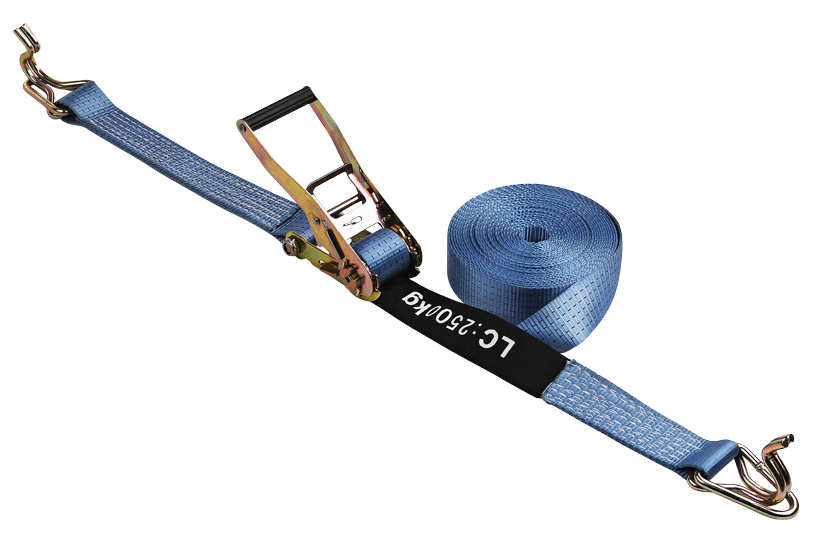
- Cam buckle straps are not interchangeable with ratchet straps: cam buckle mechanisms provide spring-loaded clamping with no mechanical advantage, making them ideal for loads that can be damaged by over-tightening, while ratchet straps provide geared tensioning for heavy loads.
Cam Buckle Straps Safety Features
Cam-Loop Binding Straps: Design and Materials
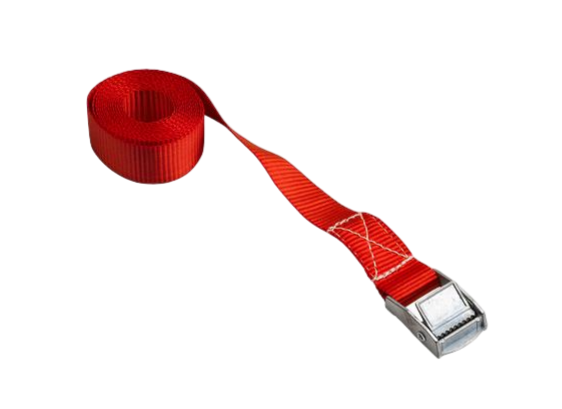
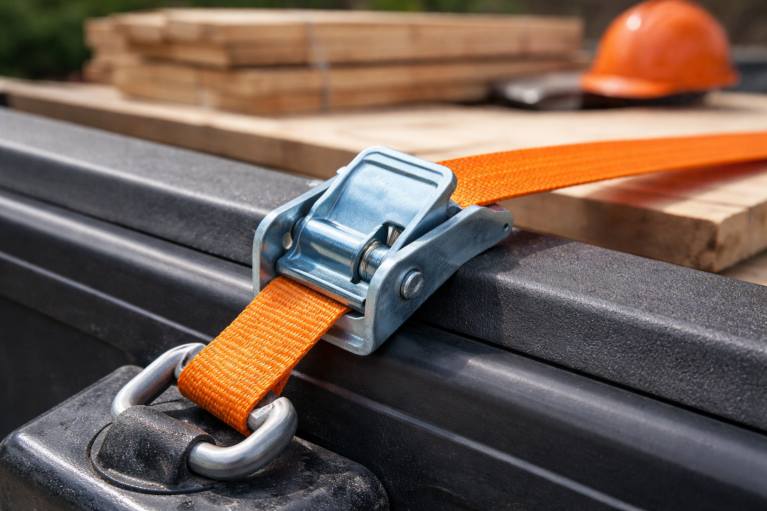
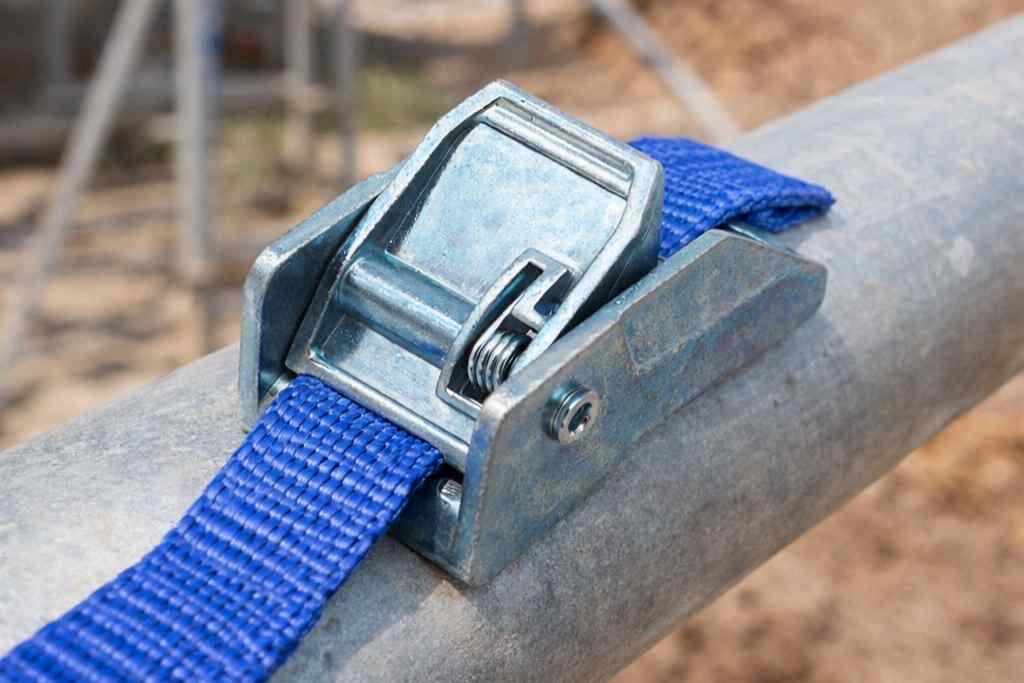
A cam buckle strap operates through a spring-loaded metal cam — a toothed gripping bar — that pivots inside the buckle housing. When the user pulls the webbing tail through the buckle, the spring-loaded cam teeth bite into the webbing and hold it under tension. Unlike a ratchet strap, which uses a gear and pawl mechanism to multiply the user’s input force (providing a mechanical advantage of up to 3:1), a cam buckle has no mechanical advantage: the tension on the strap is limited to what the user can pull by hand. This absence of mechanical advantage is precisely what makes cam buckle straps suitable for fragile loads, as it prevents the over-tightening that can crush or deform cargo.
The table below lists key design features that help cam-loop binding straps maintain security and reliability:
| Design Feature | Description |
|---|---|
| Loop Configuration | The CamJam mechanism makes a fixed loop to hold loads. It works like other cam-lock devices. |
| Lockout Configuration | You can move the CamJam mechanism along the webbing loop. This stops it from moving by accident. It gives a mechanical tensioning advantage of up to 3-to-1. This makes it safer to use. |
| High Strength Materials | The straps use high-density weave polypropylene webbing and a die-cast zinc alloy mechanism. These materials make the straps strong and reliable when holding loads. |
| Controlled Release | The webbing capture ring lets you release tension slowly. This stops sudden unloading and keeps things safe when using the strap. |
Easy to Use
The critical distinction between cam buckle and ratchet mechanisms is often misunderstood. Cam buckle straps are not “lower quality” versions of ratchet straps; they are purpose-built for applications where hand-tensioned restraint is sufficient and where over-tightening would be counterproductive. A typical EN 12195-2-compliant cam buckle strap with 25 mm polyester webbing carries an LC of 200 daN and an MBS of 400 kg, providing a 2:1 safety factor that ensures the webbing yields before the hardware fails.
The table below lists the main mechanisms that make cam-buckle straps easy and safe to use:
| Mechanism | Function |
|---|---|
| Cam buckle design | Lets you fasten quickly and release easily. |
| Controlled tension | Stops over-tightening and keeps delicate cargo safe. |
| Spring-loaded cam | Holds the webbing tight and stops slippage when tension is applied. |
Cam Buckle Straps Common Safety Concerns
Common Safety Concerns
Three failure modes account for the majority of cam buckle strap incidents: overloading beyond the rated LC, incorrect application that bypasses the buckle’s designed locking mechanism, and degradation of materials through wear or environmental exposure.
Overloading
A cam buckle strap loaded beyond its Lashing Capacity will fail predictably at the stitching or webbing, not at the buckle — this is by design under EN 12195-2, which requires the webbing assembly to yield at its weakest point (the stitch pattern) rather than at the hardware, ensuring a controlled failure mode. The most common overloading scenario is not a single heavy item but the cumulative weight of multiple unweighed items loaded incrementally without checking the strap’s LC.
Improper Use
A partially fastened cam buckle — where the webbing tail is threaded through the buckle but the cam has not fully rotated into its locked position — will release under vibration within minutes of travel. The audible click of the cam seating into the webbing is the operator’s confirmation that the mechanism is engaged. Straps that are too long for the load create a second risk: excess webbing beyond the buckle can flap in the airstream, abrade over time, and eventually compromise the loaded section.
Wear and Damage
Polyester webbing degrades through three primary mechanisms: UV exposure (prolonged sunlight embrittles surface fibres), mechanical abrasion (repeated friction against sharp cargo edges or vehicle anchor points), and chemical contamination (fuel, battery acid, or cleaning solvents can weaken the polymer structure without visible damage). A strap that looks superficially intact may have lost 30–50% of its original strength through cumulative UV exposure alone — one reason EN 12195-2 mandates annual inspection by a competent person in commercial use.
Safe Use of Cam Buckle Straps
Step-by-Step Guide
The correct sequence for securing cargo with a cam buckle strap is systematic and must be followed in order:
- Pre-use inspection. Examine the full length of webbing for cuts, fraying, or chemical staining; verify the cam teeth are free of debris and the spring returns the cam to its home position; confirm the EN 12195-2 label is present, legible, and matches the strap’s intended use.
- Position and thread. Route the strap over the cargo and through a rated anchor point on each side of the vehicle. Thread the webbing tail through the cam buckle slot from underneath, ensuring the webbing lies flat and untwisted along its entire length.
- Tension and verify. Pull the webbing tail to hand-tighten until the strap sits firmly against the cargo. Press down on the cam to confirm it has seated into the webbing with an audible click. Do not use tools, levers, or extension bars to increase tension — the cam buckle mechanism is not designed for mechanical advantage and will fail if levered.
- Secure excess webbing. Tie off, tuck, or use a velcro wrap to secure the loose tail so it cannot flap in the airstream or catch on roadside obstacles.
- Release safely. Press the release trigger and allow the cam to lift gradually, releasing tension in a controlled manner. Rapid release can cause the strap to snap back, injuring the operator or damaging cargo.
Cam Buckle Straps Limitations
Limitations: When to Choose Ratchet Straps Instead
Cam buckle straps occupy a specific performance envelope. They are the correct choice when the cargo weight falls within their rated LC (typically up to 500 daN), when over-tightening would damage the load, and when the operator needs rapid, repeatable engagement — scenarios common in parcel delivery, moving vans, motorcycles on trailers, and light construction materials. Outside this envelope, ratchet straps or chains become necessary.
Switch to ratchet straps when:
- The load exceeds the strap’s LC after accounting for the FMCSA 50% aggregate WLL rule — for example, a 600 kg machine tool requires a minimum total WLL of 300 daN, which may exceed what a single cam buckle strap can provide.
- Dynamic loads (shifting cargo, suspended items, or loads subject to wind lift at highway speeds) require the higher pre-tension and mechanical advantage (typically 3:1) that only a ratchet mechanism can deliver.
- The load must be compressed — for example, stacked timber or bagged materials — where the 3:1 mechanical advantage of a ratchet strap generates the compressive force that a cam buckle cannot.
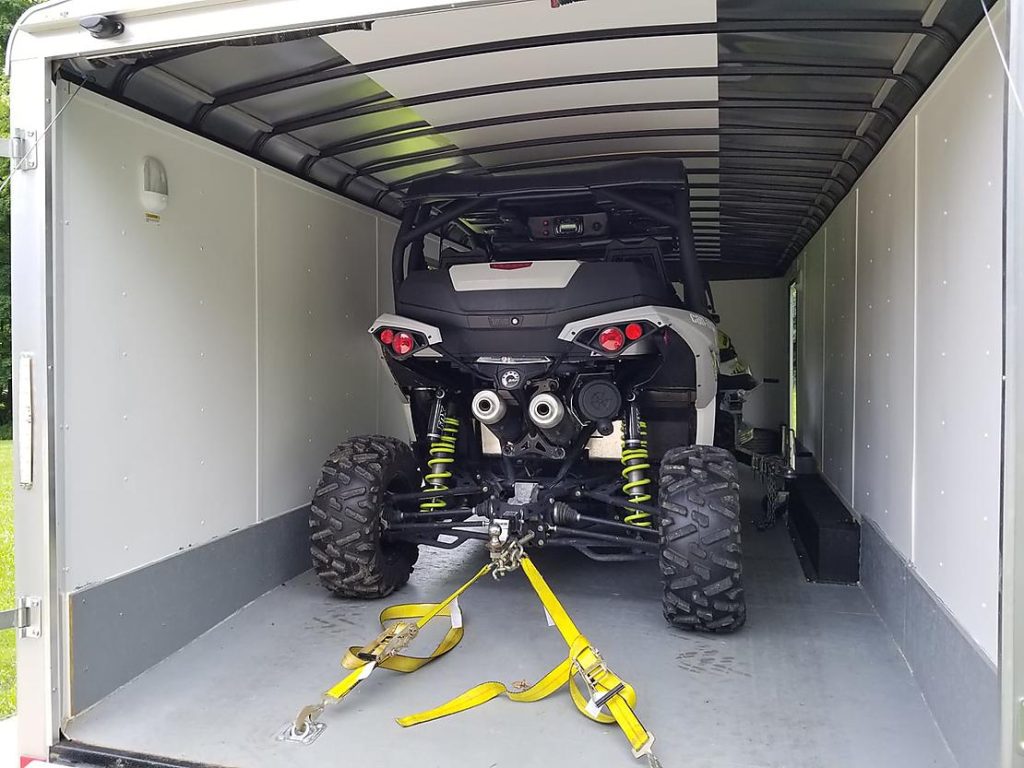
- Regulatory requirements — such as securing vehicles on car transporters or heavy plant on flatbeds — mandate chain or ratchet systems under DVSA and FMCSA guidance.
Cam Buckle Straps Safety Tips
Inspection and Maintenance
Pre-use inspection is not a recommendation — it is a legal obligation under both UK and EU cargo securement regulations. EN 12195-2 requires that lashing equipment be inspected by a competent person at intervals not exceeding 12 months, with records retained and made available for review. The following checklist operationalises the EN 12195-2 inspection criteria:
| Checkpoint | What to Inspect | Fail Criteria |
|---|---|---|
| 1. Label | Legibility of EN 12195-2 label (manufacturer, LC, material, traceability code) | Label missing, illegible, or information contradicted by physical inspection |
| 2. Webbing — cuts | Full length of webbing, both edges, both faces | Any cut deeper than 10% of webbing thickness; any cut exposing core yarns |
| 3. Webbing — abrasion | Surface fraying, fuzzy texture, reduced thickness | Abrasion covering >10% of any cross-section; visible thinning at contact points |
| 4. Webbing — chemical | Staining, stiffness, colour change, chemical odour | Any chemical staining; any area of webbing that is stiffer or more brittle than adjacent areas |
| 5. Stitching | All stitched seams, particularly at the buckle end | Broken, pulled, or missing stitches; any stitch row with >3 consecutive broken stitches |
| 6. Hardware | Cam teeth, spring, buckle housing, hooks, anchor fittings | Cracks, deformation, corrosion pitting, cam teeth worn flat, spring fails to return cam |
Storage: Store straps in a dry, dark environment away from direct sunlight and chemical sources (fuel cans, batteries, cleaning solvents). Hang or loosely coil straps rather than leaving them under sustained tension or folded at sharp angles, which can create permanent creases that weaken the webbing at that point. Applying a light lubricant to the cam pivot pin is acceptable, but lubricants must never contact the webbing — petroleum-based products degrade polyester fibres.
Cam buckle straps are a safe, purpose-built cargo restraint solution when used within their rated Lashing Capacity (typically 200–500 daN), manufactured to EN 12195-2 with high-tenacity polyester webbing and a cast steel cam buckle, and inspected before each use against the six-point checklist detailed in this article. Their absence of mechanical advantage — often mischaracterised as a limitation — is a deliberate design feature that protects fragile cargo from over-tightening damage, distinguishing them from ratchet straps for applications where hand-tensioned restraint is sufficient. Safety depends on three factors the user controls: selecting a strap with the correct LC for the load, performing the pre-use inspection without exception, and verifying that the strap carries a legible EN 12195-2 label with its LC, manufacturer, and material code. When these three conditions are met, a cam buckle strap is a compliant, predictable, and effective cargo restraint device suitable for a wide range of light commercial and domestic transport applications.
FAQ
Are cam-buckle lashing straps suitable for outdoor use?
Cam-buckle lashing straps withstand sun and rain, making them ideal for outdoor use. Made with durable materials, they ensure your goods stay safe in all weather conditions.
How often should cam-buckle lashing straps be inspected?
Cam-buckle lashing straps should be inspected before each use. Checking for any damage helps prevent accidents and ensures the safety of your goods.
Can cam-buckle lashing straps secure heavy equipment?
Cam-buckle lashing straps are best suited for securing small to medium-sized goods. Heavy equipment requires stronger lashing straps, such as ratchet lashing straps or chains.