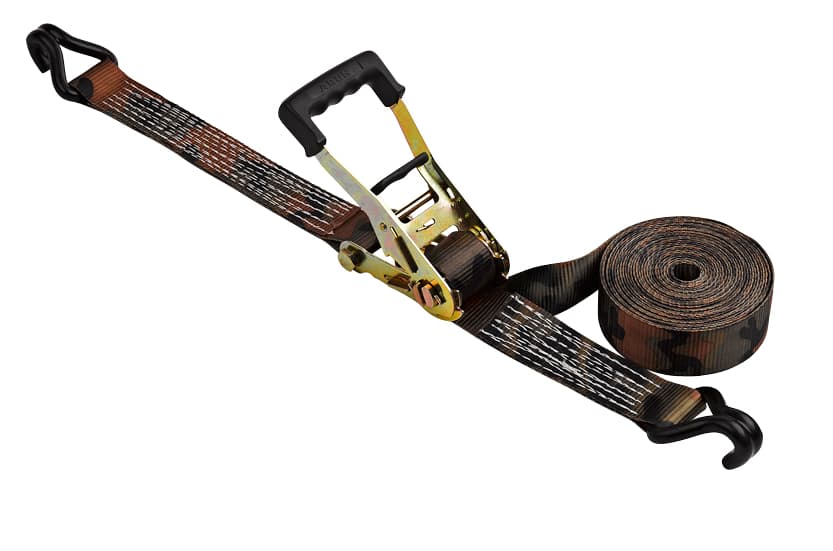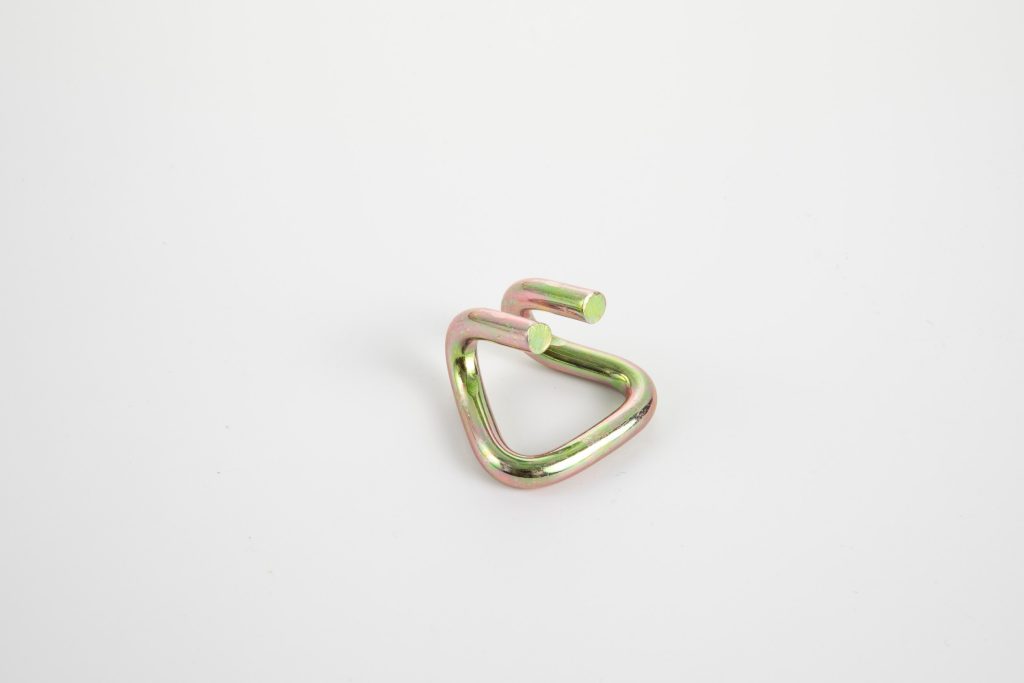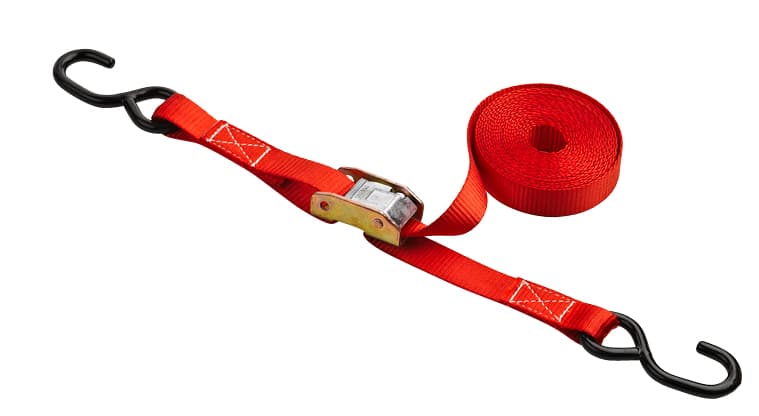
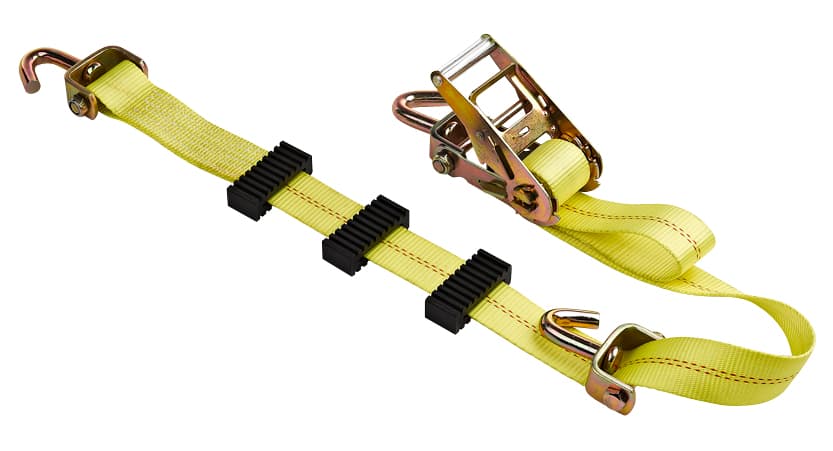
The Working Load Limit (WLL) of ratchet straps refers to the maximum weight that the strap assembly can securely hold under normal use conditions. According to the WSTDA, WLL equals the Minimum Breaking Strength (MBS) divided by a safety factor of 3:1—for example, a strap with an MBS of 15,000 lbs has a WLL of 5,000 lbs. According to the FMCSA, the total WLL of all straps must be at least 50% of the cargo weight, and the securing system must restrain the cargo in four directions: front-to-back, left-to-right, and vertical.
Key Takeaways
- Working Load Limit (WLL) = Maximum Breaking Strength (MBS) / 3 — Ratchet straps use a 3:1 safety factor according to WSTDA T-1 standards. Always use the Working Load Limit (WLL), not MBS, when planning loads.
- The total Working Load Limit (WLL) of all straps must be at least 50% of the cargo weight. For example, a 10,000-pound load requires straps with a total Working Load Limit (WLL) of 5,000 pounds.
- Check the four elements on the label: Working Load Limit (WLL), Breaking Strength, Manufacturer’s Name, and Production Date.
- Recheck every 50 miles/3 hours, as cargo may shift during transport.
- Ratchet straps are irreparable. Regardless of their Working Load Limit (WLL), any holes, tears, cuts, broken stitches, abrasion, melting, or chemical burns will render the strap unusable.
Ratchet Strap Working Load
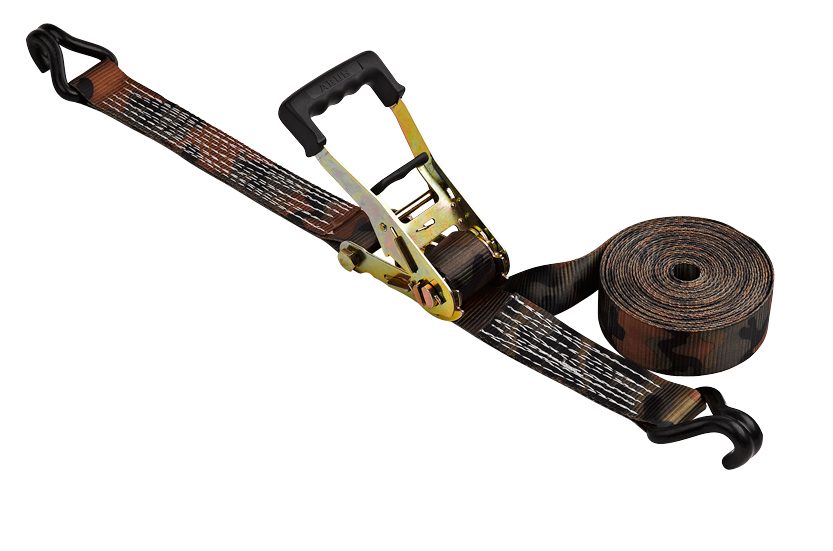
What Is Working Load?
Working Load Limit (WLL) refers to the maximum load a ratchet belt assembly can safely withstand under normal use. According to the WSTDA T-1 standard, WLL is calculated by dividing the Minimum Breaking Strength (MBS) (the minimum force required for failure of any component of the ratchet belt) by a safety factor of 3:1.
WSTDA T-1 and EN 12195-2 are the two main standards regulating ratchet belt design and ratings. WSTDA T-1 is a North American standard covering webbing slings and binding assemblies; EN 12195-2 is a European standard applicable to binding straps used in road transport. Both standards mandate a 3:1 safety factor. OSHA 1926 H subsection references these standards for construction and material handling applications.
Two related but distinct concepts:
- Proof Load: A one-time test load (typically 2x WLL) applied to verify that the strap assembly can handle a specific overload without permanent deformation. Proof load is not a working rating — it is a manufacturing QC test.
- Ultimate Load / MBS: The absolute failure point. All components — webbing, stitching, ratchet mechanism, end fittings — are tested to destruction. The lowest individual failure value becomes the assembly MBS.
Working Load Limit vs. Breaking Strength
Some people confuse working load limit with breaking strength, but they are not the same. Working load limit refers to the safe weight a strap can withstand under normal use. Breaking strength refers to the maximum tensile force a strap can withstand before breaking. Manufacturers use a safety factor to calculate the working load limit based on breaking strength.
Here is a simple formula:
- Working Load Limit = Breaking Strength / Safety Factor
The safety factor for straps is typically 3:1. This means the breaking strength is three times the working load limit. For example, a steel cable with a breaking strength of 1800 lbs has a working load limit of 600 lbs.
The table below shows the difference between the two:
| Term | Definition | Example |
|---|---|---|
| Breaking Strength (BS) | The most force a strap can take before it breaks. | A strap with a breaking strength of 1,800 lbs will break if loaded past this point. |
| Working Load Limit (WLL) | The safe weight that can be used often with no risk. | A strap with a WLL of 600 lbs can safely hold loads up to that weight. |
The quality of the material also affects both the working load limit and the breaking strength. Polyester straps are strong, durable, and have low elongation, making them ideal for securing goods. Baoying uses tough webbing and rust-resistant hardware to ensure that every strap meets industry standards.
FMCSA 49 CFR 393: The Legal Framework
In the United States, cargo securement on commercial motor vehicles is governed by FMCSA 49 CFR 393.100-393.136. Three critical requirements:
- Aggregate WLL = 50% Rule: The combined WLL of all tie-downs must be at least 50% of the cargo weight (393.110). For a 10,000 lbs load, you need straps with total WLL >= 5,000 lbs — for example, two straps rated 3,333 lbs WLL each.
- Four-Direction Restraint: The securement system must prevent cargo movement in all four directions — forward (80% of cargo weight force), rearward (50%), lateral (50%), and vertical (20%) per 393.102.
- 50-Mile First Check: Drivers must stop and re-check tie-downs within the first 50 miles of travel, then every 3 hours or 150 miles thereafter (393.108).
Why 3:1 Matters During Emergencies
During emergency braking, dynamic forces on cargo can reach 2-3x the static load. The 3:1 safety factor is not arbitrary — it ensures the strap survives emergency conditions without failing. A strap loaded to exactly its WLL at 5,000 lbs will experience approximately 10,000-15,000 lbs of force during a 0.6g emergency stop, which stays within the 15,000 lbs MBS. Loading a strap above WLL erodes this buffer: at 7,500 lbs static (1.5x WLL), emergency forces can reach 15,000-22,500 lbs — exceeding MBS.
Common Mistakes
| Mistake | Why It Fails | Fix |
|---|---|---|
| Insufficient aggregate WLL | Two 2,000 lbs WLL straps on a 10,000 lbs load = 4,000 lbs = only 40% | Use three straps or upgrade to higher WLL |
| Relying on friction alone | Rubber mats do not replace tie-downs; friction coefficients degrade with moisture and vibration | Friction aids supplement but do not replace straps |
| Not securing all 4 directions | Forward-only strapping allows lateral shift during turns | Use diagonal lashing pattern for multi-direction hold |
| Failing to re-check | Webbing settles and stretches after initial loading; straps that were tight at departure can loosen within 10-20 miles | Stop within 50 miles; re-tension; repeat every 3 hours |
Ratchet Strap Inspection, Usage & Selection Guide
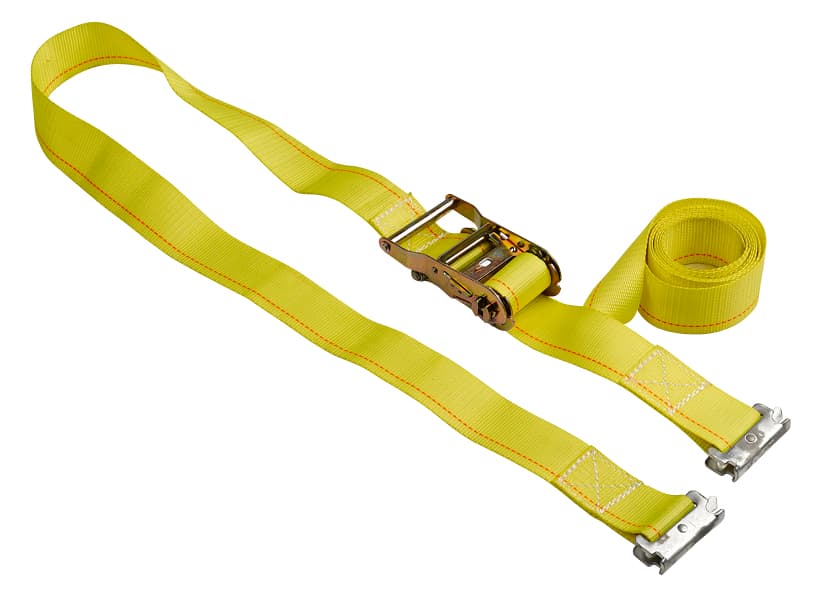
Part A: How to Check the WLL Tag (4 Elements)
Every ratchet strap must carry a permanently affixed tag with four mandatory elements per WSTDA T-1 and EN 12195-2:
- Working Load Limit (WLL): The maximum safe working load, typically in lbs or daN. This is the number you use for load planning.
- Breaking Strength / MBS: The minimum force at which any component fails. Should be exactly 3x WLL for ratchet straps.
- Manufacturer Identification: Name or registered mark of the manufacturer — traceability is essential for recall and liability purposes.
- Date of Manufacture: Month and year. Straps have a finite service life; textile webbing degrades over time even without visible damage.
Part B: 9-Point Pre-Use Inspection Checklist
Before every use, inspect each strap for these disqualifying conditions. If ANY item is true, retire the strap immediately:
| # | Condition | Threshold | Why It Disqualifies |
|---|---|---|---|
| 1 | Holes or punctures | Any size, any location | Stress concentration = failure initiation point |
| 2 | Tears or cuts | Any depth into webbing fiber | Cross-sectional area permanently reduced |
| 3 | Snags or pulled threads | 3+ adjacent pulled threads | Load distribution disrupted across weave |
| 4 | Embedded particles | Grit, metal shavings, glass embedded in fibers | Internal abrasion during tension cycling |
| 5 | Broken stitching | Any broken stitch in load-bearing seam | Stitching is the primary load transfer mechanism |
| 6 | Abrasive wear | Visible thinning or fuzzy surface >1″ length | Fiber diameter reduced = reduced tensile capacity |
| 7 | Melting or heat damage | Any hardened, glossy, or fused area | Polyester Tg exceeded; polymer structure altered |
| 8 | Chemical burns | Discoloration, stiffening, or surface pitting | Chemical degradation breaks polymer chains irreversibly |
| 9 | Illegible or missing tag | Tag cannot be fully read | WLL unverifiable = strap unratable = unsafe |
Part C: Strap Selection Decision Tree
Follow these four steps to select the correct straps for any load:
- Step 1 — Calculate Required WLL: Weigh your cargo. Multiply by 0.5 (50% rule). Example: 8,000 lbs cargo = 4,000 lbs total WLL needed.
- Step 2 — Determine Strap Count: Divide total required WLL by individual strap WLL. Example: 4,000 / 3,333 (per 2″ strap) = 2 straps minimum. Add 1 extra for loads over 10 ft or irregular shapes.
- Step 3 — Match End Fittings: Verify that hooks, D-rings, and ratchet mechanisms all carry WLL >= the webbing WLL. A 5,000 lbs WLL strap with 3,000 lbs WLL hooks is a 3,000 lbs WLL assembly.
- Step 4 — Verify Standard Compliance: Ensure straps are labeled per WSTDA T-1 (North America) or EN 12195-2 (Europe). Counterfeit straps may show ratings that cannot be verified.
FAQ
What is the difference between WLL (Working Load Limit) and SWL (Safe Working Load)?
WLL and SWL are not the same, though some industries use them interchangeably. SWL is an older term historically used in lifting and rigging (cranes, hoists) before standardized testing protocols existed. WLL is the modern term defined by WSTDA T-1 and EN 12195-2 with specific testing requirements. For ratchet straps, always use WLL — this is the term on the label, in the standards, and in FMCSA regulations. The key distinction: SWL often incorporated an additional operator judgment factor, while WLL is purely derived from MBS / Design Factor.
What does the 3:1 safety factor actually mean in practice?
The 3:1 safety factor means the strap’s MBS is three times its WLL. Practically, this ensures that during emergency braking (where dynamic forces reach 2-3x static load), the strap stays within its MBS. For example, a strap at 5,000 lbs WLL experiences ~10,000-15,000 lbs of force during a 0.6g stop — still within its 15,000 lbs MBS. The 3:1 factor also compensates for webbing degradation from UV exposure, abrasion from normal use, and minor loading irregularities. It is not a “margin for overloading” — loading above WLL erodes the emergency buffer.
How many ratchet straps do I need for my load?
Calculate in two steps: (1) Total required WLL = cargo weight x 0.5. For 8,000 lbs cargo, you need 4,000 lbs total WLL. (2) Strap count = Total WLL / individual strap WLL. With 3,333 lbs WLL straps, you need 2 straps. FMCSA 393.106(d) additionally requires a minimum of one tie-down for every 10 ft of cargo length — for a 20 ft load, minimum 2 straps regardless of WLL. Add one extra strap for irregularly shaped loads or when the load is not blocked against a front-end structure.