A ratchet strap is designed to secure cargo, while towing a car brings rolling weight and sudden shock loads that push well beyond that job. That is why a ratchet strap is not legal for towing on public roads and unsafe in almost every case.
Regulators treat towing as a separate job from securing cargo. Pennsylvania’s Vehicle Code, for example, requires a slow-moving vehicle emblem on any towed vehicle traveling on a highway. A driver who tries to tow with ratchet straps skips every approved hitch, chain, and lighting standard that inspectors look for.
Nbby1’s ratchet straps take this further within the job they are built for, covering working load limits from 500 to 10000 lbs with zinc anti-corrosion coating and ODM/OEM support.
Key Takeaways
- Towing a car with a ratchet strap is illegal on public roads.
- Ratchet straps cannot handle the strong forces of towing a car.
- Safety rules for towing vary by state, but all require rated equipment.
- Use a tow bar, trailer, or professional tow truck for safe towing.
- Breaking the rules can lead to fines, accidents, and denied insurance claims.
Why ratchet straps can’t tow a car
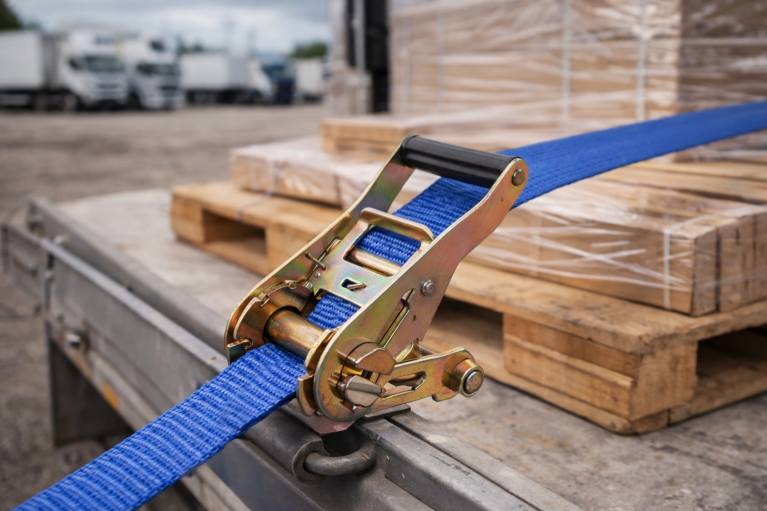
Static load rating vs. dynamic towing force
A ratchet strap is built to hold a load still. Its working load limit describes static holding capacity, not pulling power. Towing changes the physics completely. The force on the strap rises and falls with every bump, brake tap, and turn.
USA Ratchet explains the difference clearly. Cargo securement deals with weight that stays fairly constant. Towing applies a constant pull that fluctuates sharply during acceleration, deceleration, and uneven terrain. Those spikes matter more than the steady number on the label.
Xstrap Cargo quantifies the spikes. Hard braking multiplies force by 2.5 times the static weight. A pothole impact multiplies it by 3.0. A sudden start adds 2.2 times, and a sharp turn adds 1.8. A 4,000 lb car can therefore generate a shock load above 10,000 lbs. A 2-inch ratchet strap carries a working load limit of 3,333 lbs and a break strength of 10,000 lbs, according to Xstrap Cargo. That margin disappears in an instant.
Elongation tells the rest of the story. Polyester webbing stretches only about 3 percent at its working load limit, per Xstrap Cargo. A nylon tow strap of the same width stretches roughly 12 percent. That stretch absorbs shock. Polyester passes the full jolt straight to the hardware, the hook, and the bumper.
Securing a car is not the same as pulling one
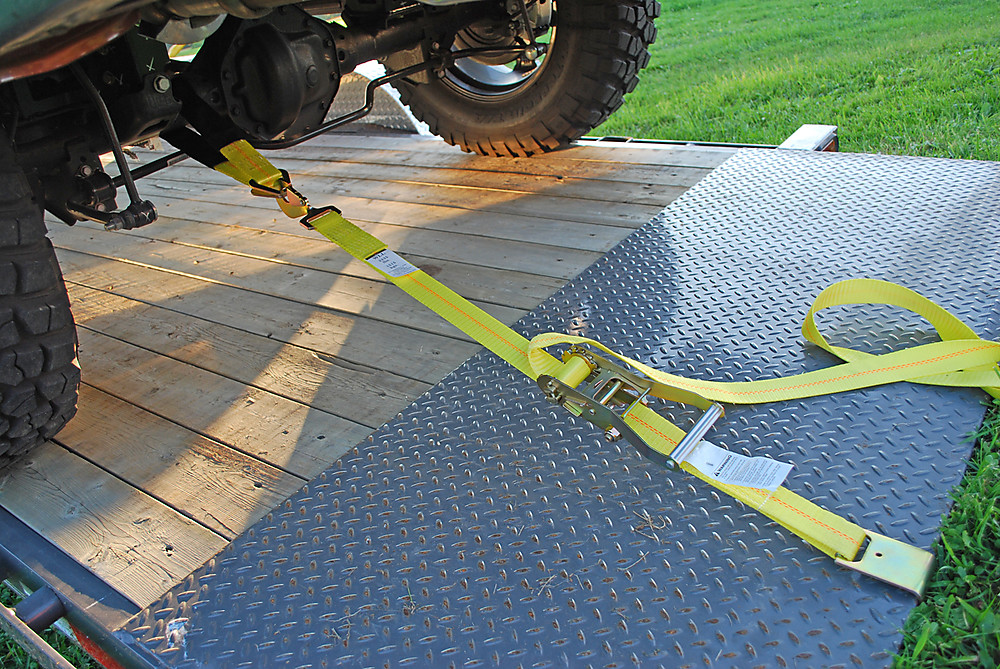
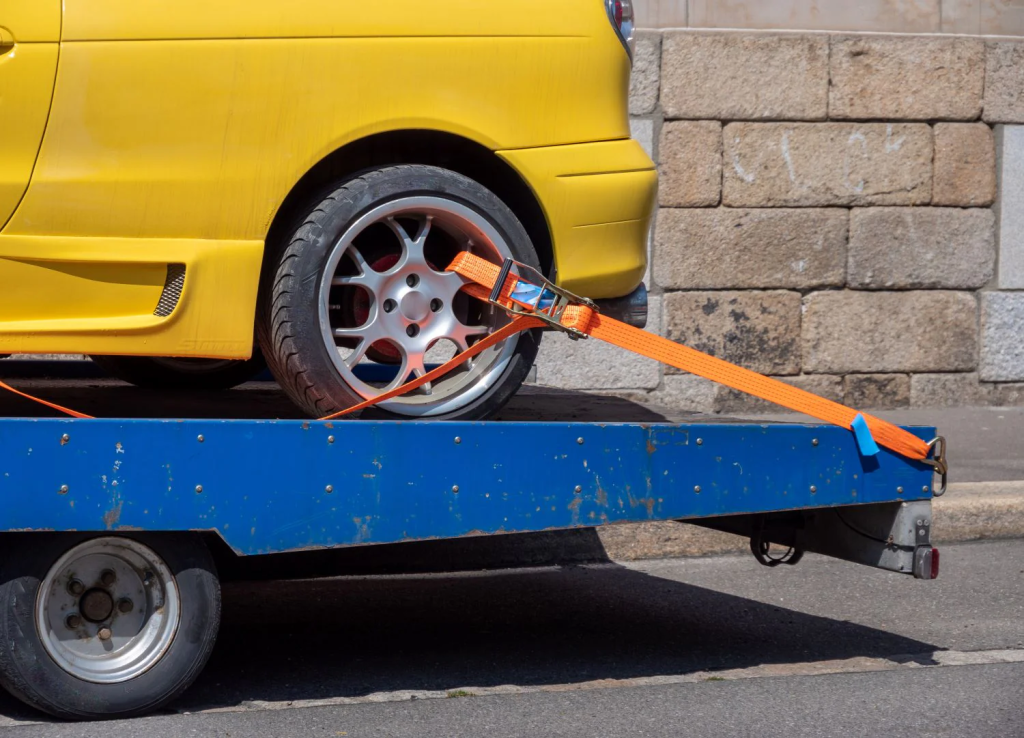
Ratchet straps excel at one job: holding a vehicle in place on a trailer or transporter. Taut-Strap notes that ratchet straps are perfect for securing cars to trailers, yet they cannot pull or lift. The distinction is simple. A tied-down car does not move, so the strap sees steady tension. A towed car rolls, jerks, and swings, so the strap sees violent peaks.
Polyester tie-down webbing should never serve as a recovery tow strap. RatchetStraps.com warns that the wrong webbing can damage the vehicle and lead to costly repairs. Nylon stretches under load, and that stretch relieves tension on bumpers, wheels, and frame parts. Polyester offers almost none of that cushioning.
The ratchet mechanism itself does not help. It generates tightening force for compression, not pulling, per Xstrap Cargo. A driver who hooks a ratchet strap to a stranded car mistakes a cargo tool for a recovery tool.
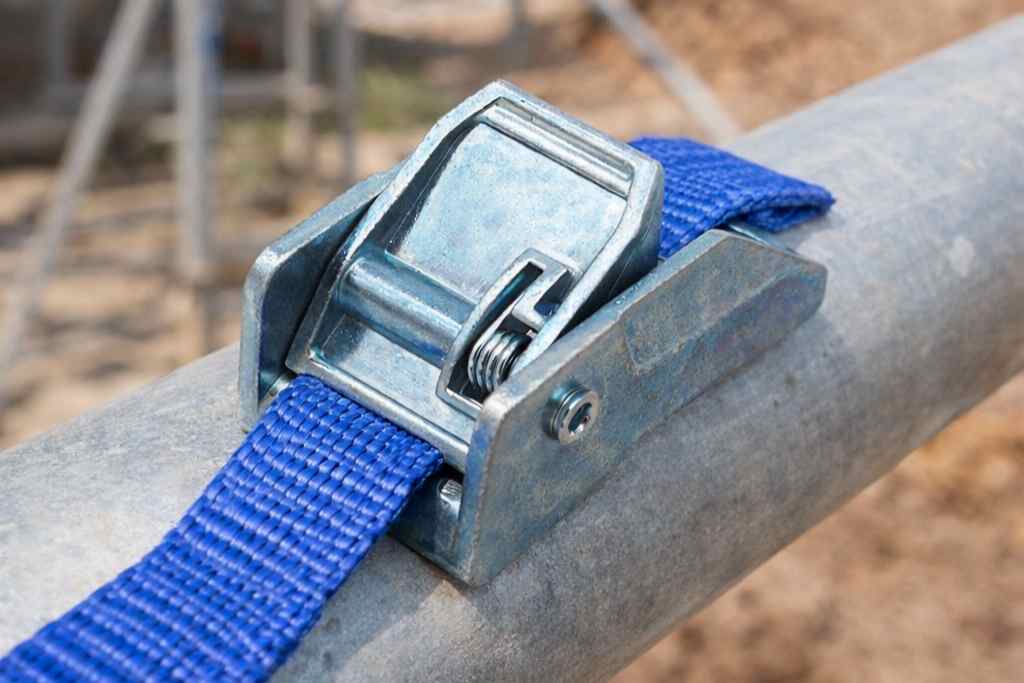
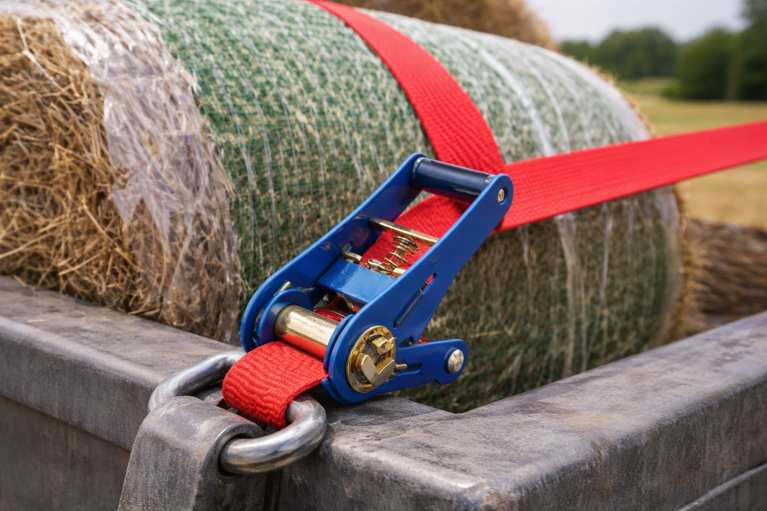
BAOYING tie down straps illustrate where this hardware belongs. The lineup includes ratchet, cam buckle, and over-center styles with working load limits from 1,000 to 10,000 lbs. These straps shine at cargo control. A driver can secure the wheels with ratchet straps on a flatbed and trust the load. The same strap should never be used for towing a car. Keep the four wheels tied down on a trailer deck, and leave the pulling to rated tow straps.
Is towing a car with ratchet straps illegal?
In practice, yes — the practice is illegal in some areas and legally risky everywhere else. Towing equipment must be approved for the job and kept in good condition. General cargo webbing fails both tests, because no regulator approves it as a pulling device. The sections below explain what the codes demand, why the answers differ by state, and what a violation costs.
What safety regulations require
Regulators build equipment rules around rated hardware. Pennsylvania’s Vehicle Code shows the pattern clearly. The state requires a slow-moving vehicle emblem on any towed vehicle traveling on a highway, unless the towing vehicle displays the emblem so it is clearly visible from the rear. The code also sets lighting and reflector requirements for implements of husbandry and special mobile equipment designed to operate at 25 mph or less.
| Item | Federal recommendations based on the standards from the ASAE | PA Requirements |
|---|---|---|
| Headlights | 2 white headlights; Mounted on either side of vehicle centerline at same height | Same as ASAE recommendation |
| Taillights | 2 red taillights; Symmetrically mounted to rear between 1.3′ to 12′ and no greater than 5′ to left and right of machine center. | One mounted at each side on rear |
| Hazard Flashers | Minimum of 2 amber flashers; Symmetrically mounted to rear between 1.3′ to 12′ and symmetrically spaced as widely apart as practicable to be visible from front and rear (60 – 85 flashes/min) | Two if double-faced with amber to front and red to rear; Four if single faced – amber on front corners and red of rear |
| Turn Indicators | 2 amber or red turn indicators; Mounted 1.3′ to 12′ high and symmetrically spaced as widely apart as practicable to be visible from front and rear. | Not required |
| SMV Emblem | 1 fluorescent red-orange triangle for daylight with red retroreflective border for nighttime; Mounted on rear center or rear left for maximum visibility of 1,000 feet day or night, 2′ to 10′ above ground. | All implements of husbandry designed to operate at 25 mph or less shall always display the SMV on rear of vehicle on highways. |
| Reflectors | 2 red reflectors on rear of machine; 2 yellow reflectors on front of machine; May be either part of tail lamp lens or made with conspicuous material. Size to be 2″ wide by 4.5″ long for machines <6.7′ wide; Size to increase to 2″ by 9″ for wider machines which are >6.7′ wide. | One red reflex reflector or reflective tape at rear on each side; One amber reflex reflector or reflective tape at front on each side with size of reflector to be 3 square inches or more. |
| Rotating Beacons | Not required | One flashing or revolving yellow light or strobe light |
| Conspicuous material to better define size and to increase visibility (machinery or towed equipment) | Red retroreflective and red-orange fluorescent material to be visible to rear; Mount on rear corners within 25″ of left and right outer corners of the machine; Distance between materials should not exceed 6′; Yellow retroreflective material to be visible to front. Mounting to be within 16″ of outside corners. | SMV only |
The pattern matters more than the numbers. Inspectors look for hardware with a stated rating and a permanent attachment. A hook slipped over a bumper meets neither condition. Gear used for towing without a rating leaves the driver outside the rule. A driver cannot point to a strap’s break strength and call it approved equipment. The code also covers condition. Worn webbing, bent hooks, and stretched chain all fail inspection, even on a licensed truck.
Why the rules vary by state
State legislatures write their own vehicle codes, so the details shift at every border. Some states allow a vehicle to be pulled behind a tow hitch with a chain or strap, yet ban that method on highways. Others restrict nylon tow straps outright, since nylon stretches far more than polyester under load. A driver who plans towing a car with a truck across state lines should read each state’s code first. Local police enforce local rules, and a method that passes in one county may fail in the next. Enforcement varies as well. A rural department may wave a driver through, while a highway patrol unit in the same state writes a citation. The patchwork creates real confusion for drivers who haul vehicles for a living.
What happens when a driver breaks the rules
The penalties reach further than a ticket.
Using inappropriate equipment can result in fines, legal repercussions in case of an accident, and even invalidate your insurance coverage.
USA Ratchet lists three exposures: citations, liability after a crash, and denied claims. An insurer can refuse a claim when the driver skipped approved gear. A court can assign fault on the same basis. A citation also raises premiums after the fact. Anyone who wants to tow a car should confirm the equipment meets local safety standards before the wheels roll. A ratchet strap carries no load rating for pulling, so it never clears that check. Documentation helps too. A driver who keeps the rating label and the inspection record can answer an officer’s question on the spot. The cost of a proper tow bar or a professional hookup is small next to a denied claim.
Risks of towing with a ratchet strap
Strap failure and sudden breakage
A ratchet strap can break without any warning. USA Ratchet says even a top-quality strap is not strong or stretchy enough for the steady strain of towing. Pay close attention to the hooks. They are not made for the strong forces of a pull, so they can slip off or snap in the middle of the road.
Wear and tear makes the danger worse. Discount Ramps lists the warning signs that inspectors and drivers should look for:
- Fraying along the edges or across the webbing
- Scrapes from rough surfaces and sharp edges
- Holes that make the whole strap weaker
- Burn marks and stiffness from heat or chemicals
- Faded color, a sign that UV protection is wearing out
- Rust, corrosion, and a stuck ratchet mechanism
- Broken teeth that cannot hold tension
- Slipping after tightening
- Mildew and rot from damp storage
Discount Ramps also notes that most makers suggest replacing ratchet straps every 2 to 4 years. Old fibers get brittle and snap under load.
Accidents, damage, and penalties
The break itself is only the beginning. USA Ratchet warns that a snapped strap can cause serious injury or property damage. The sudden release of tension creates a whiplash effect. That snap-back can hit both vehicles and anyone standing nearby.
Towing a car with one also damages the hardware. USA Ratchet explains that the forces can bend, tear, or completely break the tow points. Repairs follow, and the driver gets the bill. A proper tow hitch and rated safety chains spread the load instead.
Legal trouble adds to the cost. An officer can ticket a driver for unapproved equipment. An insurer can deny a claim after a crash. Anyone towing a car with a truck across state lines should check each area’s rules first. The safer path is simple: save ratchet straps for cargo, and use rated gear for towing a car.
Tow straps and proper alternatives
Recovery straps, chains, and tow bars
The right gear depends on the job. A driver who needs to pull a stuck vehicle free should reach for recovery straps. These straps stretch under load and release energy slowly, so they take the shock instead of sending it to the frame. A driver who needs to move a car down the road should use a rigid tow bar or a proper trailer. Chains work well for heavy recovery jobs where scraping is a concern.
A driver who wants to tow a car with a truck needs rated hardware at every connection. That means a tow hitch bolted to the frame, safety chains crossed under the coupler, and a secure attachment point on the disabled vehicle. A driver should attach the tow strap to a factory tie-down point, never to a bumper or steering part. Drivers who attach tow straps to weak metal risk bending the frame. The same rule applies when they tow another vehicle with your truck on a public road.
Using tow straps correctly starts with reading the label. A tow strap carries a working load limit, and the driver must match that limit to the weight of the car. Using tow straps beyond their rating invites failure. The safer way to tow a car is a purpose-built dolly or a flatbed, where ratchet straps hold the wheels down and no pulling force touches the webbing.
When to call a professional tow truck
Some situations sit beyond any DIY setup. Stearns Companies draws the line at serious roadside accidents, where damaged vehicles, blocked lanes, and safety risks make expert service essential. Towing moves a vehicle from one place to another. Recovery extracts a damaged or stuck vehicle that may be overturned, buried, or trapped. The second job calls for heavy-duty trucks, winching systems, and trained specialists who understand physics and safety procedures.
Untrained operators make predictable errors, according to Stearns Companies. They hook cables to weak vehicle parts and warp the frame. They overload light-duty winches and risk cable snaps or rollovers. They ignore load balance, and uneven pulls twist axles. Each mistake adds cost. A driver who faces a rollover, a ditch, or a commercial accident should call a professional rather than improvise.
A ratchet strap is not a legal or safe way to tow a car. The webbing is built for static cargo, and the pulling forces of towing a car rise far beyond that rating. State rules differ, yet every one of them expects rated hardware. A failed strap brings damage, injury, and denied claims.
Drivers should use a tow bar, a trailer, or a professional tow truck for towing. Ratchet straps belong on cargo, where they hold a vehicle down on a deck. Anyone who plans to tow a car should read the local code first and confirm every connection carries a proper rating.