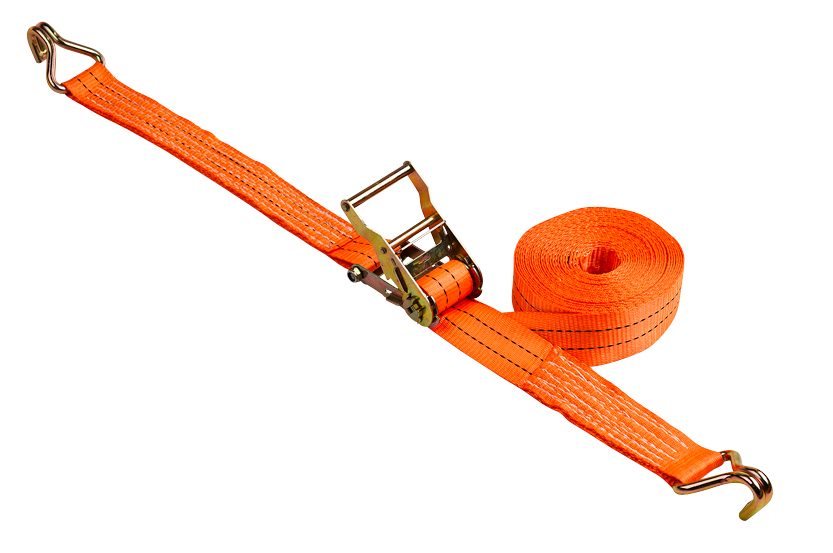
When it comes to securing cargo, choosing the right tie-down strap isn’t just about convenience—it’s about safety and legal compliance. If you are wondering how much weight a standard 2-inch ratchet strap can handle, the short answer is: It typically has a Working Load Limit (WLL) of 3,333 lbs and a Breaking Strength of 10,000 lbs.
However, depending on the duty rating (light, medium, or heavy-duty) and hardware configurations, the actual capacity can vary. This guide breaks down everything you need to know about 2-inch ratchet strap weight capacities, safety margins, and compliance standards.
Key Takeaways
- Always rely on WLL, not Breaking Strength: Never load a strap beyond its Working Load Limit.
- Industry Standard: Most heavy-duty 2-inch polyester ratchet straps offer a 3,333 lbs WLL.
- The 3:1 Safety Factor: Breaking strength is always 3 times the WLL according to web sling and tie-down association standards.
- Mandatory Inspection: Prior to every trip, check for burns, tears, or hardware deformation. Damaged straps must be replaced immediately.
Understanding Ratchet Strap Load Ratings: WLL vs. Breaking Strength
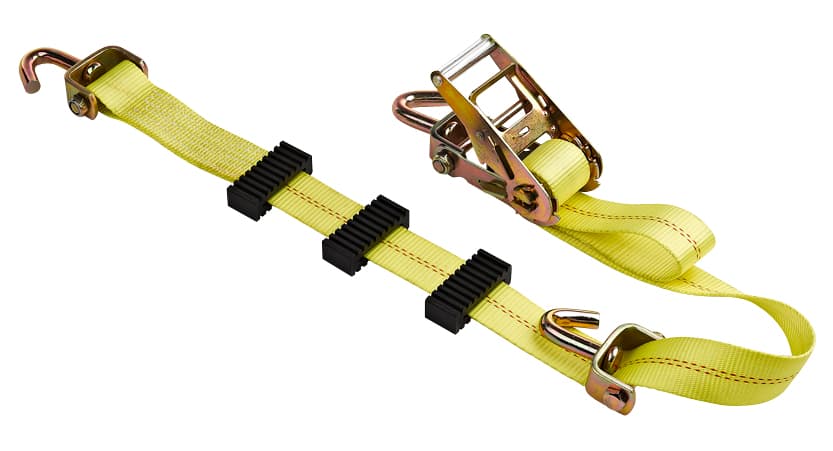
To safely secure your load, you must understand the two primary ratings permanently printed on any certified strap’s tag.
1. Working Load Limit (WLL)
The Working Load Limit (WLL) is the maximum allowable weight a strap can safely support under normal operating conditions. According to the Department of Transportation (DOT) and Federal Motor Carrier Safety Administration (FMCSA) regulations, cargo securement systems must be calculated based strictly on the aggregate WLL of the straps used.
2. Breaking Strength (BS)
Breaking Strength is the absolute maximum force a tie-down assembly can withstand before structural failure occurs (snapping or warping). The entire assembly’s rating is determined by its weakest component—whether that is the polyester webbing, the ratchet mechanism, or the end hooks.
The Golden Rule of Cargo Tie-Downs:
Working Load Limit (WLL) = Breaking Strength/3
A standard heavy-duty strap with a 10,000 lbs breaking strength yields a safe working load limit of exactly 3,333 lbs.
| Strap Duty Type | Width | Working Load Limit (WLL) | Assembly Breaking Strength |
| Light/Medium Duty | 2 inch | 500 – 1,500 lbs | 1,500 – 4,500 lbs |
| Heavy-Duty (Standard) | 2 inch | 3,333 lbs | 10,000 lbs |
| Industrial / Premium | 2 inch | 4,00 |
Key Factors That Affect Ratchet Strap Capacity
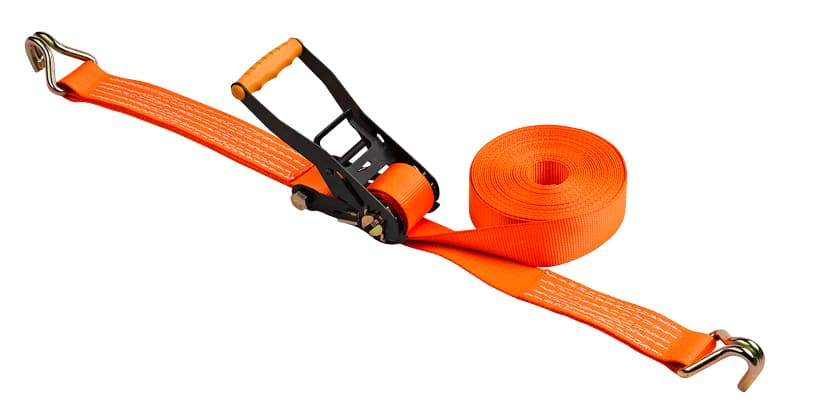
Not all 2-inch straps are built equal. Several crucial elements dictate how much weight a strap can reliably handle over its lifespan:
Premium Webbing Material
High-quality tie-downs utilize 100% high-tenacity polyester webbing. Polyester is preferred over nylon for cargo control because:
- Minimal Stretch: It keeps cargo tightly locked in place even over bumpy terrains.
- Environmental Resistance: It offers superior resistance to UV rays, moisture, rot, and localized abrasion.
Hardware Integrity
The ratchet handle, gear mechanisms, and hooks must be forged from high-grade structural steel. To comply with commercial transport standards, high-end manufacturers like BAOYING ensure all hardware undergoes rigorous proof-testing and features a zinc-plated or galvanized coating to resist rust and corrosion.
Size Comparison at a Glance
If a 2-inch strap doesn’t match your load requirements, consider industry standard alternatives:
- 1-Inch Straps: Best for light duty, ATVs, and dirt bikes (WLL: 500 – 1,100 lbs).
- 2-Inch Straps: Perfect for commercial hauling, vehicles, and heavy building materials (WLL: 1,466 – 3,333 lbs).
- 3-Inch & 4-Inch Straps: Designed for flatbed trucking and massive industrial machinery (WLL: 5,400 – 6,000+ lbs).
Safe Usage Tips & FMCSA Compliance
Securing a load haphazardly can lead to catastrophic failures, fines, or accidents. Follow these professional guidelines to ensure maximum safety:
- The Two-Strap Minimum: Per FMCSA regulations, you must use at least two tie-downs if your cargo is longer than 5 feet or heavier than 1,100 lbs.
- Aggregate WLL Calculation: The combined WLL of all your tie-downs must equal at least 50% of the total weight of the cargo you are carrying. For absolute safety, many fleet operators prefer a 100% aggregate capacity ratio.
- Avoid Sharp Edges: Use corner protectors or wear sleeves. Sharp metal edges can slice through polyester webbing under tension like a knife.
- Never Over-Tighten: Forcing the ratchet handle beyond its natural hand-tight limit can damage the internal spring mechanisms or warp your cargo.
Common Mistakes to Avoid
- Using Twisted Straps: A twist in the webbing concentrates stress on a narrow strip, reducing the effective WLL by up to 50%.
- Ignoring the Tag: If the safety identification tag is missing, illegible, or torn off, the strap is legally deemed to have a 0 lbs WLL during DOT inspections.
- Neglecting Storage: Storing wet or dirty straps in closed toolboxes encourages mildew and rapid material degradation.
When Should You Replace Your Ratchet Straps?
Even if a strap is only a few months old, you must retire it immediately if you observe:
- Fraying, holes, snags, or severe surface cuts.
- Burn marks from exhaust pipes or chemical exposure.
- Broken, bent, or heavily rusted ratchet gears and hooks.
- Faded webbing color (an indicator of severe UV degradation).
Professional operators recommend replacing heavy-use cargo tie-downs every 2 to 4 years, regardless of visual condition, to account for unseen microscopic fiber fatigue.
Why Choose Certified Cargo Gear?
When hauling heavy loads, trust is everything. Premium tie-down solutions from certified manufacturers like BAOYING guarantee peace of mind. Every product is rigorously tested to meet global safety standards, including ISO 9001, CE, and European GS certifications. With customizable lengths, heavy-duty hardware options, and clear, durable compliance tags, BAOYING keeps your business compliant and your cargo rock-solid.
FAQ
Can I use a 2-inch ratchet strap to lift objects vertically?
Absolutely not. Ratchet straps are strictly rated for cargo tie-down and securing applications. They are not engineered, tested, or approved for overhead lifting or towing. For lifting, always use certified overhead lifting slings.
What should I do if my ratchet handle gets stuck and won’t release?
Do not force it with a pry bar, as this can snap the mechanism dangerously. Spray a small amount of penetrating oil (like WD-40) into the rotating gear assembly, pull back the release spring trigger completely, and gently rock the handle forward to relieve pressure before pulling it wide open.
Can I knot two straps together to make them longer?
No. Tying knots in polyester webbing drastically weakens the fabric fibers, reducing its breaking strength by over 60%. Always use a single strap of the correct length, or chain multiple certified D-rings appropriately.